Some know him as Sasquatch. Others call him Bigfoot. Could the Pacific Northwest’s favorite cryptid actually be real?
Documents released by the United States Forest Service in October show evidence that the federal government has, to some extent, pondered the question.
You can read the files for yourself here.
The U.S. Forest Service has released records from a 1982 investigation into tracks in Washington’s Mill Creek Watershed.
The file also includes black-and-white pictures from its Umatilla National Forest investigation and two memos that walk through what investigators found.
The earliest document is dated 1980 and appears to be an account by Leo T. Kinney, a longtime resident familiar with the Petty Creek and Alberton area of Montana, describing encounters with an unusual, large animal in 1949 and 1950.
Near the end of his report, Kinney asks for the government to contact his family, saying “we have pictures” of the Bigfoot-like creature.
It is not clear whether the government took him up on his offer. However, two years later, wildlife biologist with the Forest Service, Rodney L. Johnson, was in Oregon investigating a series of large footprints in the Umatilla National Forest.
Johnson said the large prints were found in three locations throughout the area: one near the Low Creek Trail, one near Low Creek Ridge, and the last one near an unnamed trail near the top of Low Ridge.
Johnson concluded from studying the marks that they were made by “something other than a 300-pound two-footed being” and that the imprints showed evidence that something may have been “rocked back and forth” to create the prints.
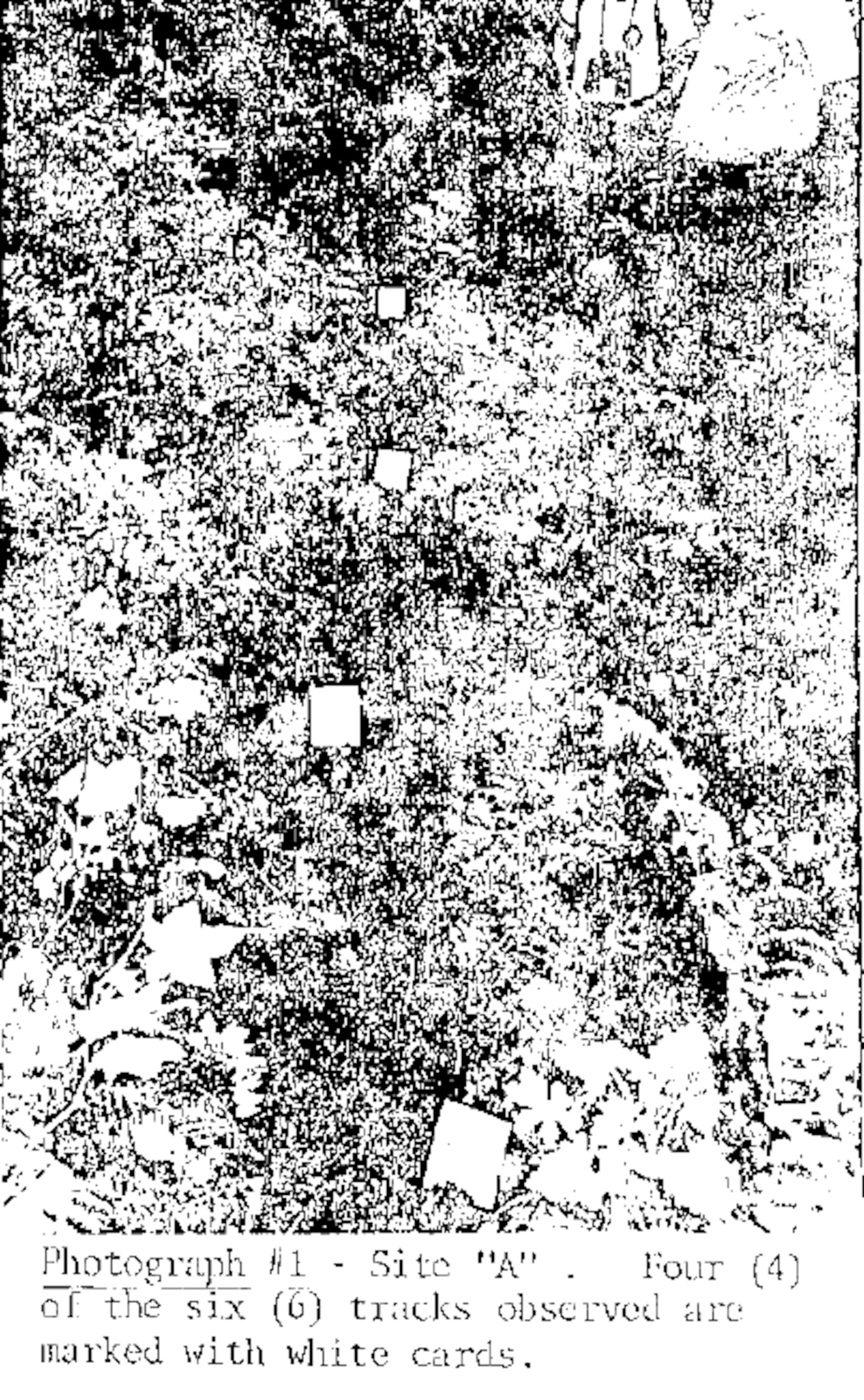
Johnson’s report includes photographs of the prints, including crime-scene-style markers indicating each piece of evidence.
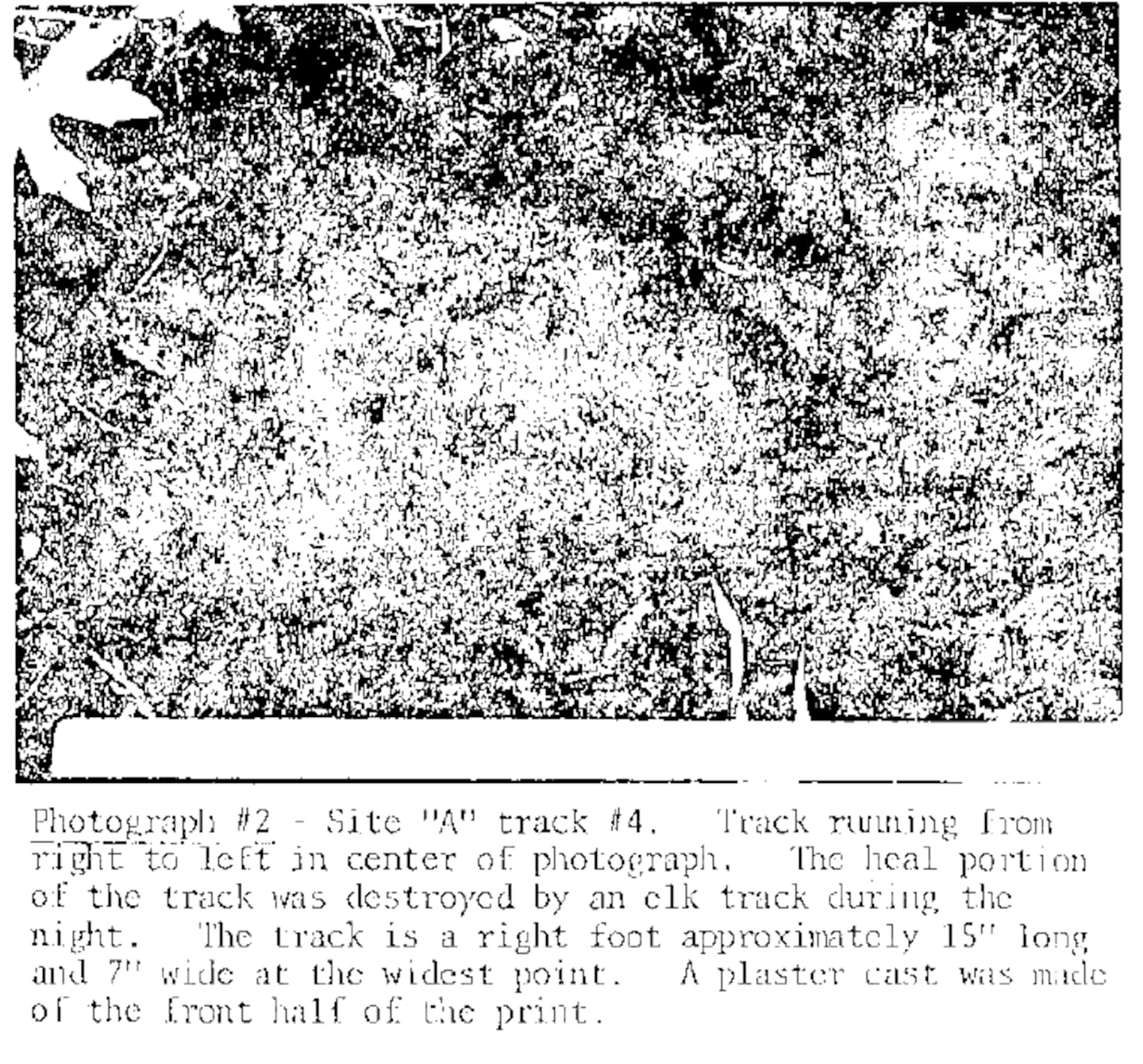
One black and white photo shows a single, large footprint, which the report says ran 15 inches long and 7 inches across at the widest point.
However, Johnson also said in his report that if the prints were fakes, they must have taken a great effort to reproduce, saying that the “print marks on the foot would have been very hard to duplicate. They appear to be natural.”
The final document, a clipping of a newspaper article from the Clark Ford Valley Press in Plains and Sanders County in Montana details how eight-year-old Austin Peterson found large footprints while walking in the woods.
Neighbors said they originally thought the prints were from a bear, that is until they saw the toes, which were described as human-like.
Bob Mesing,a neighbor of Peterson, who also saw the tracks, said there were hundreds. Mesing said he followed the trail for roughly 100 yards into the woods before losing it as snow thinned.
Mesing said, based on the tracks, the creature must have had a five foot stride and feet over 16 inches long and 8 inches wide, figures very close to the ones measured by Johnson in his Oregon investigation.
“I don’t know if I believe in the Bigfoot theory, but the tracks were right there,” Mesing said in the article.
The document dump is part of a larger move from the Trump Administration to release documents related to popular conspiracies.
©2026 Cox Media Group