SEATTLE, Wash. — Thursday marks two years since one of the most violent windstorms Western Washington has experienced in recent years: the so-called “bomb cyclone” of Nov. 19, 2024.
The storm killed two people in Western Washington and knocked out power to more than a half-million customers. One woman was killed when a tree fell on a homeless encampment in Lynnwood, while another woman died after a tree fell onto her Bellevue home. Hospitals also reported treating multiple injured people.
The power failures were staggering. More than 656,000 customers across Washington were without electricity at one point, with Puget Sound Energy reporting nearly half a million customers without power in its service area alone. The utility warned early on that some customers should prepare for a multi-day outage.
But this storm didn’t sneak up on forecasters.
The various forecast models were pretty unified in taking a low-pressure system far out in the Pacific and turning it into a monster storm within 24 hours.
In his Pinpoint Forecast from the evening before the storm, KIRO 7 Chief Meteorologist Morgan Palmer forecast the storm bottoming out at 942 millibars, a unit that measures the air pressure in a weather system.
And that’s exactly where it wound up: 942 mb. However, Palmer says now it’s possible the storm briefly became even stronger between observations.
“Bomb cyclone” comes from the meteorological term bombogenesis, the rapid strengthening of a storm as its central pressure plummets. The classic benchmark is a drop of at least 24 millibars in 24 hours. This storm blew right past that marker, even doubling at times.
Rapidly strengthening storms aren’t unusual in the fall in the Pacific, when colder air from the Arctic begins to spill south while very warm, tropical air continues to ride north at times. The clash of warm and cold air masses creates the conditions needed for a storm system to spin up. However, storms reaching “bomb cyclone” status rarely do so close enough to shore and in a position to produce winds this intense across Western Washington.
There is historical precedent. In November 1981, the “Friday the 13th Windstorm” developed offshore and saw its central pressure plunge roughly 50 millibars in 24 hours. That storm knocked out power to about 400,000 homes and businesses, produced a 67 mph gust at Seattle-Tacoma International Airport, and became one of the region’s most significant windstorms since the Columbus Day Storm of 1962.
The 2024 storm centered hundreds of miles offshore, but the low’s intensity created a tight pressure gradient, and air flowed from high pressure to the east toward the offshore low. This produced an offshore, or easterly, wind.
When that air was drawn west through gaps in the Cascades, it accelerated into areas west of the Cascade foothills.
Many of the hardest-hit areas were closer to the mountains and bore the brunt of the winds. Winds were clocked at 74 mph around Enumclaw. Farther north, where easterly wind could flow largely unabated through the Strait of Juan de Fuca, an unofficial wind gust of 99 mph was reported on a Canadian island at the southern end of Vancouver Island.
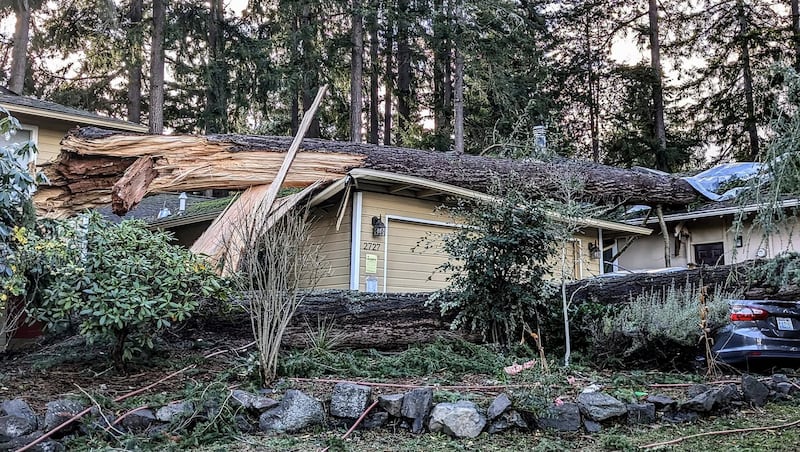
The damage on the ground reflected that uneven wind pattern. Trees fell onto homes in Issaquah and across power lines in Lake Stevens, North Bend and Black Diamond, while fallen trees and other debris blocked roads around the region.
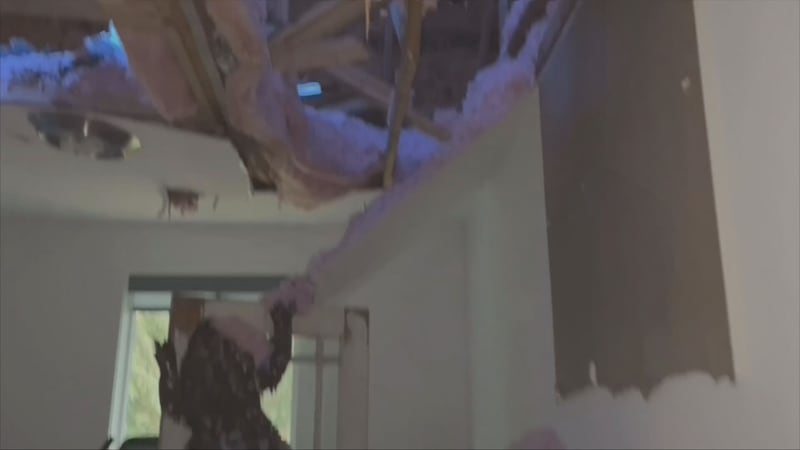
Issaquah emerged as one of the communities hit especially hard. Days after the storm, KIRO 7 spoke with residents of the Tiger Mountain community, where fallen trees had damaged homes and blocked roads. John and Jacklyn Marcus told KIRO 7 that trees had crashed into their six-month-old home, leaving its damaged roof exposed as rain moved into the region after the windstorm.
Because of the topography, however, other areas were largely untouched by the strongest winds that evening.
An unprecedented hit to the power grid
The wind’s effects extended far beyond the trees and power lines people could see from their homes.
The storm also damaged parts of Puget Sound Energy’s high-voltage transmission system, the larger network that moves electricity into communities before it is distributed through local power lines. That helped explain why some neighborhoods lost electricity even where local power lines were underground.
For thousands of people, the outage stretched on for days.
By the Saturday after the storm, PSE was pushing some restoration estimates as far back as Monday morning. The utility said damage to poles and equipment connected to its high-voltage system had complicated restoration efforts. Bellevue, Kirkland, Issaquah, Mercer Island and Sammamish were among the communities KIRO 7 identified as some of the hardest hit.
Nearly a week after the storm, thousands of customers were still in the dark as crews continued repairing the system. PSE said it had restored most of its roughly 400 miles of transmission lines damaged or affected following the storm.
The damage didn’t end when the power came back
Over the following months, the storm’s true financial scope became clearer.
Approximately 600 homes and businesses were damaged, according to KIRO 7’s one-year retrospective on the storm. Public property damage and repair costs eventually exceeded $34 million, including $14.7 million in King County.
0 of 11





The damage extended to public utilities, electrical systems, parks, schools and other government property. In January 2025, then-Gov. Jay Inslee signed an emergency proclamation that unlocked $1 million in state funding for recovery. Washington officials also sought a federal major-disaster declaration to help pay for the damage.
The state’s congressional delegation joined the push for federal disaster assistance, citing crippled utility infrastructure, damaged public and private buildings, and cleanup efforts still underway nearly two months after the storm.
But the broader federal assistance Washington requested never arrived.
FEMA denied the state’s request for a major-disaster declaration and later denied its appeal. Without that federal reimbursement, local governments were left to absorb significant portions of the cleanup costs themselves. Issaquah alone reported spending about $2.4 million from its general fund.
Some federal help was available directly to people and businesses. The U.S. Small Business Administration made low-interest disaster loans available in seven Washington counties, allowing eligible homeowners, renters, businesses and nonprofits to seek help for physical or economic losses associated with the storm.
Some families spent months rebuilding
For homeowners who took a direct hit, recovery could last far longer than the power outage.
A year after the storm, KIRO 7 returned to the Issaquah home of John and Jacklin Marcus, who said three trees had crashed through their roof the night of the windstorm. They estimated the resulting damage at roughly $400,000.
The couple said it took about six months before they could move back into the house. Their experience also illustrated another lingering consequence of the storm: determining what insurance would cover, hiring contractors and assessing which remaining trees might present a future threat.
Before-and-after photos documented similar recovery efforts in Redmond, Snohomish County, Issaquah, and Marysville, contrasting the destruction immediately after the November 2024 storm with those locations about a year later.
What changed after the bomb cyclone?
The storm didn’t just leave behind repairs. It also exposed vulnerabilities in how utilities respond to an outage of that scale.
A year later, PSE and Snohomish County PUD told KIRO 7 they had made changes based on lessons from the storm. Snohomish PUD said crews had sometimes struggled to maintain internet access in the field during the response, so the utility added Wi-Fi boosters to its trucks.
Both utilities also worked to improve their outage maps and the information provided to customers. Snohomish PUD said customers could see more information about the circuit serving them and sign up for text updates, while PSE said it had spent the year improving technology in the field and in its control center.
Those changes came from a storm whose effects lasted far longer than its peak winds. For some Western Washington communities, the Nov. 19, 2024 bomb cyclone was a matter of hours. Restoring the power took days, repairing homes took months, and settling the cost of the destruction stretched well into the following year.
©2026 Cox Media Group